
Ding dong the wicked witch still lives
Written by John MacphersonWhat connects metadata and dementia?
As any of you following this blog will know my mum has dementia, and I’ve posted several times with observations on her situation. The last couple of years contemplating my mum’s increasing confusion have made me reappraise memory. The way it defines us, the power it exerts over us and those around us, and above all its value.
When my mother fell and broke her hip, and hospitalization revealed the extent of her dementia, we were informed that she could not return to her home because of the risk she posed to herself and others. It fell to me to clear her possessions of a lifetime. I talked about this in The Last Month Turned. It was a fraught and emotional experience, taking place a long way from my home and with my (then one year old) son to look after too. Thinking ahead as ‘a photographer’ to contemplate recording anything that happened on ‘the clearing day’ was the last thing on my mind.
But I always carry a camera, and on the day I had in my pocket my tiny and always-present Ricoh GRD, the photographic equivalent of a ballpoint pen, unobtrusive and able to ‘write’ with light when needed, and I realized I should record what was happening.
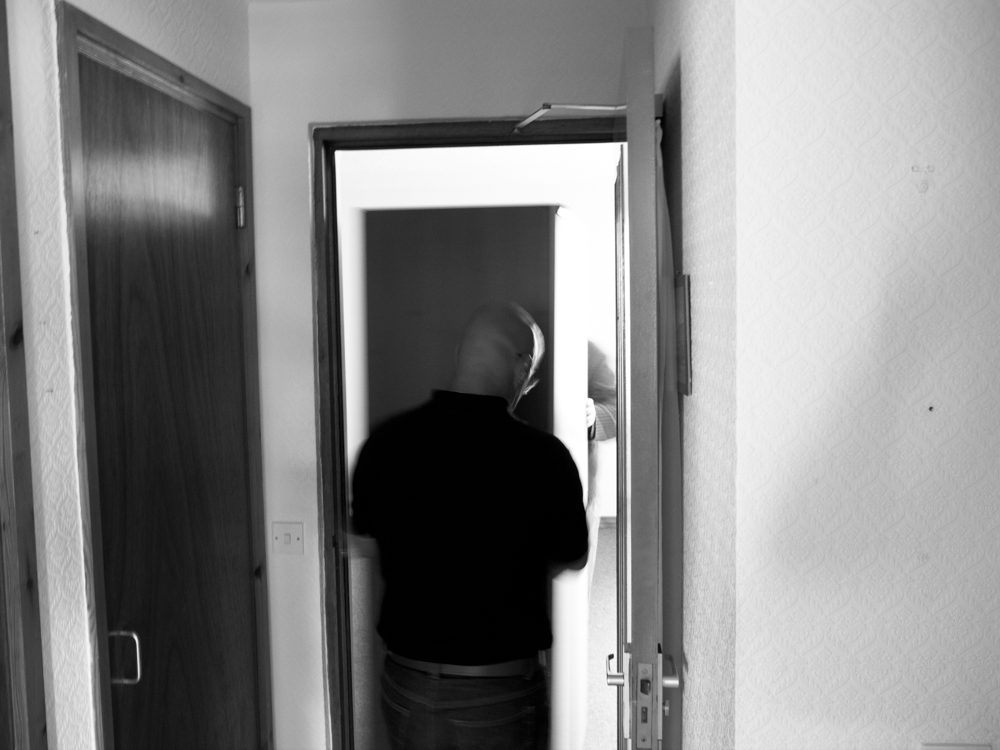
Removal of memories © John MacPherson
There was the obvious – the discoloured spot on the carpet where mum fell, breaking her hip and lying for several hours overnight, bodily functions still working, but her body blocking the front door and making entry for the emergency services a technical challenge; and of course there were the belongings being removed by a charity to go to bolster other lives: her carpets, the new widescreen tv, a sideboard, wardrobe, a whole kitchen and more, and perhaps most poignant – boxes of the well-used plates we had sat around as a family sharing meals.
But the thing that struck me the most, finally, when the apartment was emptied, was the absence of it all, the calendar still open on January, from six months past when mum fell and was removed, but above all the unfilled space where once so much had happened. It was a metaphor for memory stripped of substance by dementia, once filled with so much, now containing so little save what I remembered and could project into it.
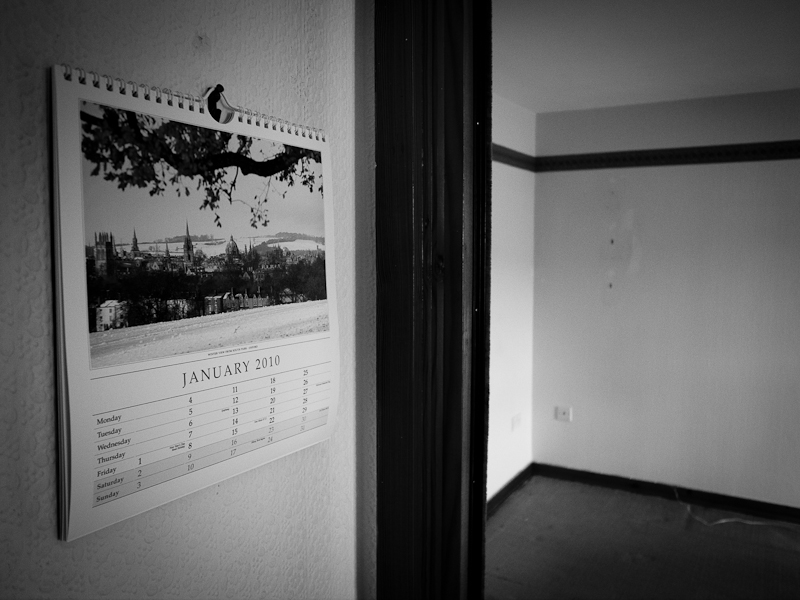
The last month turned © John MacPherson
Being asked to contribute to duckrabbit came along in the midst of all this, and it’s been a real privilege to be able to share observations with a disparate group of people. And if I’m honest in the back of my mind is the thought that with two parents who suffered from dementia will I do likewise? It may be an unspoken fear (until now) but it has certainly focused my mind on the act of recollection and writing, trying to shape those thoughts into something tangible. Many experiences are recorded in this blog. It is a vast digital memory bank. That’s something to ponder, that there might be a whole personality wrapped up in a blog that will persist long after that individual’s memory has withered. And what role those memories may have in shaping and changing other’s lives, what ‘connections’ they might make, one can only guess at. I’d not previously fully considered these wider implications of simply ‘blogging’.
Truth is, a simple story recalled, and teased out of ‘memory’, can often shape and influence others in ways that are completely unexpected.
I’ve thought about all of this recently as I listened to accounts of Margaret Thatcher’s death, and it spun around and around in my head, but as a thought only half-formed and yet to make sense. I posted a piece a few days ago about metadata, the ‘story’ of our images that is carried through the ‘world of the web’ and gives meaning to our photographs. But it can be removed, stripped by social media servers as being unnecessary and superfluous.
But those half-formed thoughts coalesced this morning as I read an astonishingly thought-provoking piece on USA Today by Michael Wolff about Margaret Thatcher and her fight against dementia ‘Iron Can’t Shield us from Everything’:
But in a world — and media — obsessed with the narrative power of disease, with its ennobling aspects and tragic poignancy, the single greatest physical scourge of our time, beyond heart disease, cancer, even malnutrition, is barely acknowledged…..Not to dismiss any of her accomplishments, but Margaret Thatcher might well have meant more to mankind if she could have become to dementia what Rock Hudson became to AIDS.
Of course, that is the point and extra tragedy of dementia: It doesn’t speak. It can’t bear witness to itself — or if it can, if the demented are aware of their own shadows, we don’t know it. Therefore, the point is how we look at it. It’s a media issue.
Note that phrase “It’s a media issue”. And what ‘social media’ does so often is strip the meaning, the metadata, from images, and casts photographic memories adrift in a sea of data where connections are lost. We have a truly remarkable opportunity to inform the future, we have images which can actually carry the story of their making and their meaning inside them. Yet we throw that information away! Why does that matter?
Here’s an image that emerged from a box of negatives my mum had concealed in her apartment. It was buried in an envelope amongst stuff, lost for decades with many other images which I have recently scanned. It shows a joyous moment, my dad hugging my mum. There is no metadata with this image, it’s simply a dusty old negative. And dementia has robbed my mother of the recollection of this event.
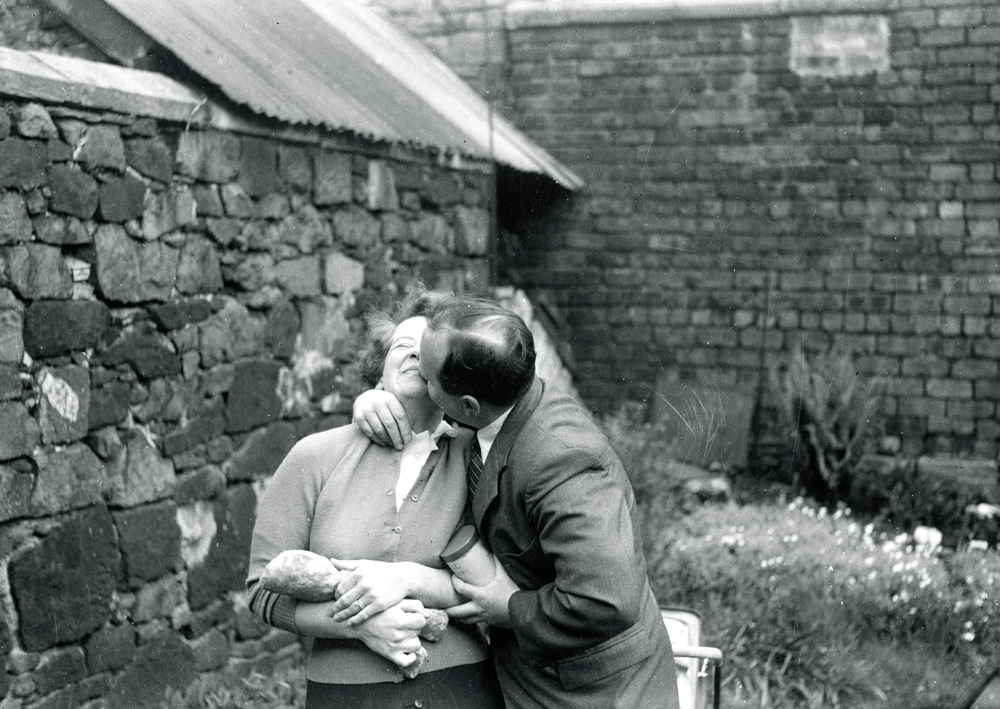
Joy © John MacPherson
What can I tell about it? It is a place I know, I was born there – I recognize the walls. There is a pram – that dates it to between 1954 and 1960, but I may not have been born when this was taken. Mum holds what looks like a teddy bear, dad carries a packet of Capital Oatcakes. But what is the moment they are celebrating? The image is almost candid, like they were unaware, but someone was there to take it. Who? I don’t know the answers to any of this, nor will I ever find out. As it is it’s a wonderful moment captured, but it holds only what I may project onto it. Is that enough?
As my mother’s confusion increases, I have come to realise that memories will be all we will have left of her. Each day for her is unpredictable, sometimes containing a joyous echo of her past, but too often not. And for we family in so many ways mum, the mum we used to know, exists only in the fragments of our collective memory. Memories that are precious, and which we now must share with each other, and with her to remind her who she is, and what she has done. The value of the stories of our shared past have increased hugely, and the accompanying images, if there are any, have become even more precious, and are ‘signposts’ of a sort, but sadly ones always pointing back from whence we’ve come.
Memory is what makes us individuals, it reminds us of our loves of yesterday, and of our fears for tomorrow. In the absence of memory there are only questions. In the absence of fear there is no ‘tomorrow’. And social media sites need to recognize this, recognize the value of that which they currently discard: metadata.
Metadata is the ‘memory of the web’, data-stripping is simply digital dementia.
I detested Margaret Thatcher’s political policies and beliefs, and the damage they wrought on this country. But she was not only a politician, and she did not die as a politician. She died, simply, as a mother, robbed of memory and ability, drifting aimlessly through her final years.
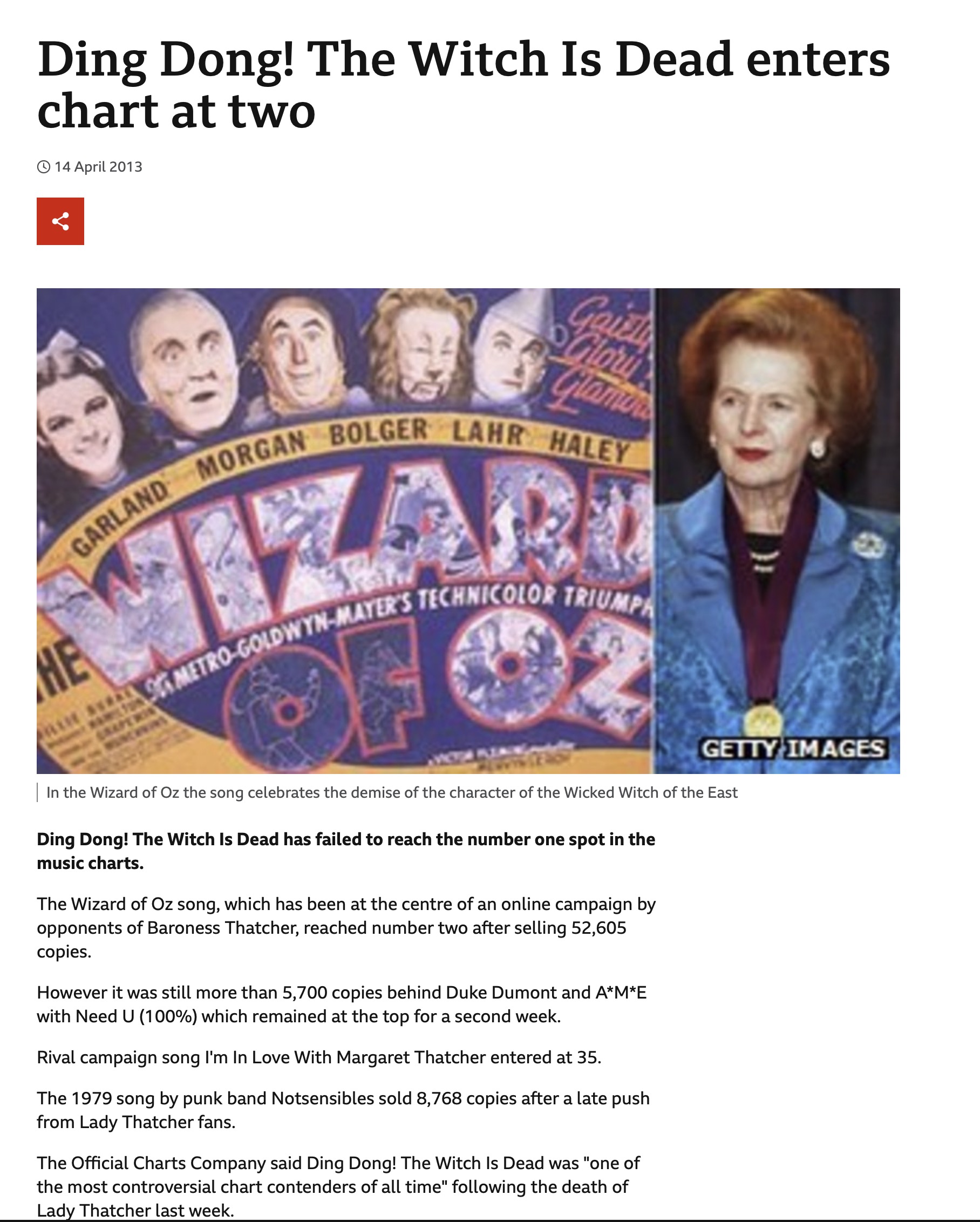
‘Ding Dong the Witch is Dead’ – so goes the now ‘controversial’ song, but in truth the icon that was Margaret Thatcher ‘died’ the moment Alzheimer’s took hold and robbed her of memory. As Wolff rightly notes, there was an opportunity missed here, by Thatcher’s proponents, one that could have celebrated her most important fight, against dementia, and that could have done a quite remarkable thing, something she did not achieve in her life: united people.
Maybe one day ‘the wicked witch’ that is dementia WILL be dead, and then we may all celebrate. Until then we must all look over our shoulders, record our memories and keep them, and our photographs of them, somewhere safe, lest she sneak up on us and cast her spell over us…..

Author — John Macpherson
John MacPherson was born and lives in the Scottish Highlands. He trained as a welder in the Glasgow shipyards, before completing an apprenticeship as a carpenter, and then qualified as a Social Worker in Disability Services. Along the way he has cooked on canal barges, trained as an Alpine Ski Leader & worked as an Instructor for Skiers with disabilities, been a canoe instructor, and tutor of night classes in carpentry, stained glass design and manufacture, and archery. He has travelled extensively on various continents, undertaking solo trips by bicycle, or motorcycle. He has had narrow escapes from an ambush by terrorists, been hit by lightning, caught in an erupting volcano, trapped in a mobile home by a tornado, kidnapped by a dog's hairdresser, rammed by a basking shark and was once bitten by a wild otter. He has combined all this with professional photography, which he has practised for over 35 years. He teaches photography and acts as a photography guide & tutor in the UK and abroad. His biggest challenge is keeping his 30 year old Land Rover 110 on the road. He loves telling and hearing stories.
Discussion (11 Comments)
Great piece, John. This is something that has been on my mind over recent times as my ma is suffering with Alzheimer’s that, thankfully, has not yet turned into dementia. As with most mental health issues, the ‘coverage’ of these illnesses could and should be better. As you say, re Mrs T’s illness, perhaps a chance missed.
Thanks Tony. This could have been a legacy Thatcher left behind that celebrated something we are all party to, may suffer from, and should be aware of. Yes, a chance missed. Take plenty pictures of your ma, get her to record stories about your past. Keep them safe.
John, an extremely moving article.
I’m very close to a similar situation with my family and your words about what memory means are quite profound. Similar sentiments are often seen when its just about photographers wanting to sell their latest printed work, but this has real depth and meaning.
I wish you and your mum the very best, inadequate though those words are.
Thank you Bob, glad it struck a chord. We take memory for granted, and it’s only when it starts to go awry that the real impact of its loss hits home. Thanks for the good wishes – and in truth there are moments of utter hilarity in amongst all this stuff that are a joy to behold, so not to lose sight of those. My mum reached a good age before she had problems but for younger people it can be devastating. Best wishes with your own journey.
Excellent piece of writing and insight. Deserves to be published – consider sending this off to the family section of the Guardian?
Thanks for your comments Phil, glad it touched you. I’m flattered by that suggestion! Will have a look at that.
I’d second Phil’s suggestion!
Thanks Tony!