
This is Not a Photo Opportunity
Written by Lewis BushI spent last weekend walking in the area around my family’s cottage near Devil’s Bridge, mid-Wales. I’ve been lucky to visit many beautiful places, but Wales has a strange aura which for me is unlike any other, a beauty which is never showy or obscene, but which is just ancient, effortless and indifferent. Glacial hills, desolate moorland, immortal woodland.
Walking for mile upon mile through these surroundings, usually carrying a camera, I’m often minded to remember the inability of photography to directly convey things. Standing at the head of a steep valley after a long climb, looking down through barren deciduous trees scattered with snow, to the sun dappled floor a thousand feet below where an icy river tears past old lead mine works, the thought alone of taking a photograph, of treating this place as another photo opportunity, seems somehow sacrilegious.
And that’s because regardless of the talent of the photographer, irrespective of the specialisation of their equipment, a photograph will never be more than a poor surrogate, a shallow replacement for the real thing. It is inevitable, no camera I have ever come across can convey what the human eye can, cameras operate in wholly different ways, under-performing in some respects, over-performing in others, but always producing something quite different from what is seen. It calls to mind the Winogrand claim to ‘photograph to see how things look photographed’ and the result is often disappointing.
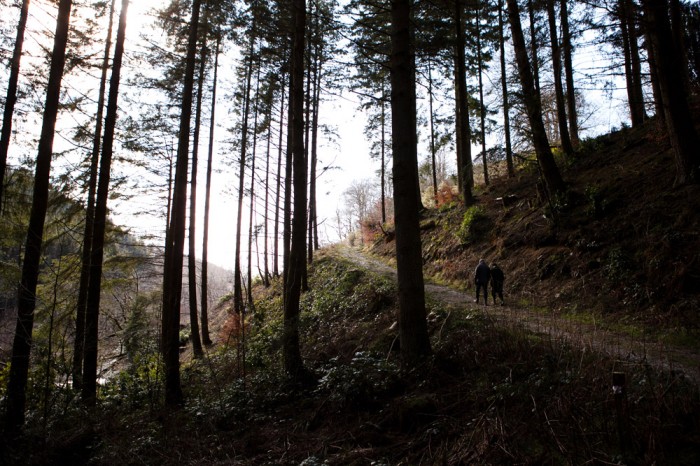
But it’s not just the consequence of optics or chemistry. The feeling looking out over that valley is a product not just of radiation, of energy, coalesced into dark and light, but of adrenaline, hyperventilation, exhaustion, cold, euphoria. All of these things come together to make something unique, an experience which cannot be conveyed by a two dimensional print or an image on a screen. Just as the camera is never ‘objective’ nor is the observer. The cameras depiction of these views is maybe even more objective than my own at the end of a long climb, but it is strangely the worse for it.
Clearly few people would claim photographs are a stand in for reality, but it is still common for people to imply as such in their language. A photograph is perhaps more of a taster for a prospective visitor, or a primer for the memory of someone who has already been. A photograph is like a flashcard, or an ink blot test, a fragment of something (or perhaps not even that).
Despite my earlier comment that to photograph in these beautiful environs seems somehow taboo, I must confess that I still often can’t resist taking a picture or two. Not so much because I still want to try and record or the preserve the beauty of what I see in front of me, but more because I am curious to test the limits of the camera. To see, in other words, how badly the camera will fail to do justice to what is in front of me, so later I can compare the failed photograph to the memory in my head, itself I should admit, also so often wholly inadequate.
Originally posted on Disphotic
Discussion (4 Comments)
Lewis, I can empathize greatly with the feelings you describe about Wales at the top of the post. I feel the same way when back visiting my family on Anglesey, or my extended family in Ireland and Yorkshire. There is an immediate feeling on “ancientness,” one that anchors me immediately when step foot back on that soil. It does indeed, photographic limitations aside, make it very difficult at times to even attempt a photograph. That may also be due to my limited time in that land these days. I appreciate your meditation.
Glad you feel similarly Ed. Perhaps time is one part of the problem, and maybe with more time you can start to find ways to outmaneuver the limits of what a photograph is capable of conveying. Thanks for commenting.
There’s certainly a connection with place that results from having lived in it.
In farming sheep it would be their being ‘hefted’ to a hill area, that knowledge they have of place that is so strong it can ‘hold’ them there without fences. They stay because they know.
And we humans have it too, an awareness of weather, history, and crucially light, that informs us beyond the ‘surface’ that any photograph can capture.
Your second paragraph says it all for me you know the light, the distance, the river rushing, the presence of the lead mine. Its that story of place that gives insight and understanding.
I’ll repeat a Barry Lopez quote I used in a recent post, because it says it all:
“We keep each other alive with our stories. We need to share them, as much as we need to share food. We also require for our health the presence of good companions. One of the most extraordinary things about the land is that it knows this—and it compels language from some of us so that as a community we may converse about this or that place, and speak of the need.”
Good quote. True also that the camera doesn’t see all the eye sees because part of what the eye sees isn’t there, history, memory, borders, territories, etc.
On an aside I’ve always been fascinated by what this part of the country would have been like before it was enclosed by fences, never heard of hefting before, interesting idea.