
Withering Memory
Written by Lewis BushI’m still processing John Macpherson’s post earlier in the week on memory, dementia, metadata. If you haven’t read it, do. It’s a mixture of great writing and great ideas, intimate personal experience and big questions. It helped to condense a few thoughts of my own on that have been drifting around in need of something to begin to draw them together.
On Wednesday I watched Margaret Thatcher’s funeral cortege pass through central London, not because I loved her, nor particularly because I loathed her, but because of the sense that I wouldn’t be likely to see something like this again. There was something very nostalgic about the experience, perhaps because it felt like an almost fetishistic reverence of the past. It was a parade both of a death leader, and of a series of redundant historic references; bear skin hats and formal uniforms, a First World War gun carriage, and of course Thatcher’s Victorian politics.
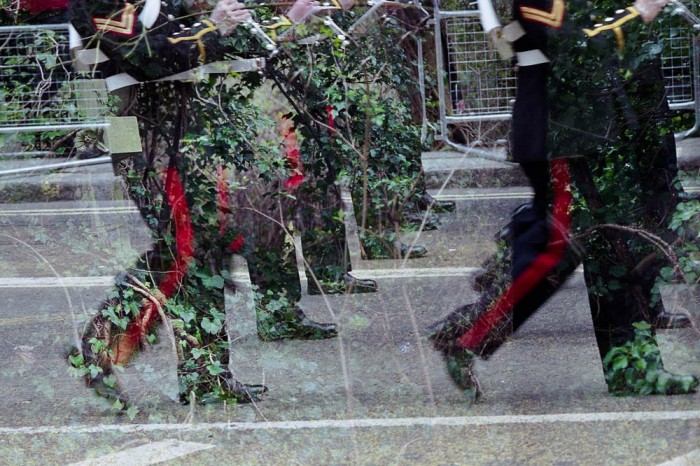
Thatcher funeral, double exposed with a neglected Victorian cemetery
As at all such events now, the response of almost all present was to try to record it. Indeed such was the density of picture taking that I remarked to a friend that if the requirement to participate in the event had been that one bring a camera and take a photo, and if those who refused these conditions were turned away, the audience would not have been noticeably diminished. I watched as thousands of people reached with smartphones and compact cameras, to snap a photograph or shoot a little video so that they could store for later recall the funeral procession of a woman whose once legendary memory had failed her.
It struck me as strange that even as we live in a time of such rampant use of mnemonic technologies like photography, at the same time seem to be experiencing such an increase in incidence, or at least awareness, of degenerative memory conditions like Parkinson’s, Dementia and Alzheimer’s. It would be foolish to suggest there is a casual connection between these two epidemics because there almost certainly isn’t one. But perhaps there is an acausal connection, some sort of cruel synchronicity between technologies like photography that seem in many ways to alleviate the burden of needing to remember, and at the same time an almost epidemic withering of our ability to recall the past. It is maybe not without reason that photography has been suggested to be ‘the crypt of memory’.
Or perhaps, to take the counter-point, there is no synchronicity, not even an acausal connection between these things. We look to confirm our biases. As we become more and more desperately caught up in the idea of saving and remembering events in photographs and video clips, we become more acutely aware of the shortcomings and failure of our own memories, more conscious of the possible importance of these technologies in compensating for the very evident limits of our own biology.
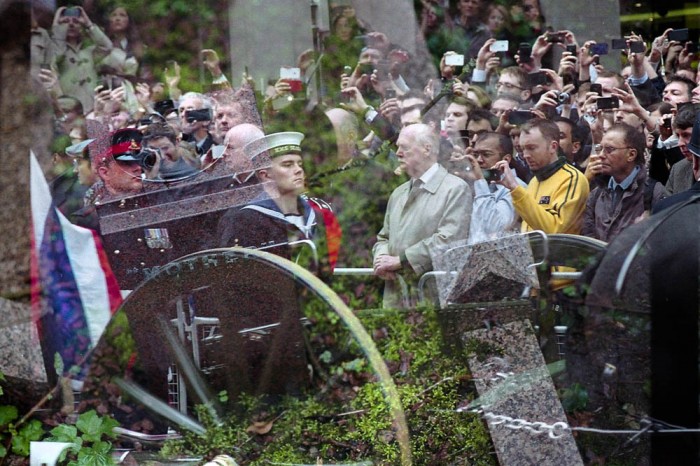
Thatcher funeral, double exposed with a neglected Victorian cemetery
But memories are like not like videos and photographs, which are static and which stand without context. An intrinsic part of memory is change, sometimes loss. It has been suggested that something is always changed in remembering, because each time a memory is accessed part of the present is re-encoded into it. Memories of childhood are not just memories of childhood, those memories stand in the context of every memory since, and every present where that memory has been accessed. We also need to come to terms with the inevitable degradation of memory, which happens with time to all things, and perhaps recognise that the bright details of what we can recall from event long passed are made all the more starkly luminescent by the black emptiness of forgetting that surrounds them.
Memory loss is something we should not accept, like many I’ve seen it’s a terrible, destructive effect first hand, and like any illness we should do everything we can to fight it. But to view our memories, as we so often do, as analogous to a picture album that is forever available and unchanging is setting ourselves up to be hopelessly disappointed. We need to get beyond seeing memories as interchangeable with photographs, and see them for what they really are, something really far more interesting, something dynamic, evolving, beautiful, alive.
Discussion (6 Comments)
Good article, Lewis. Food for thought.
Thanks for reading Tony.
“and perhaps recognise that the bright details of what we can recall from event long passed are made all the more starkly luminescent by the black emptiness of forgetting that surrounds them.”
That’s possibly the most lyrical and vivid description of memory I’ve ever read Lewis. I think I will remember that. (I hope I will!)
Thanks for writing this, and for the thought-provoking images.
Thanks John, glad you get what I mean. Not the best bit of writing, certainly not up to the standards of your piece which inspired it but yours was a great incentive for me to try and get the ideas down.
Coming from a background of studying history I’ve oddly always been more interested in the idea of forgetting than remembering. It’s so difficult to get to grips with the idea of what it means to forget something, how it happens, and most of all how it shapes what is left behind. Absences are sometimes more notable than presences if you that makes sense?
“Absences are sometimes more notable than presences if you that makes sense?”
That’s why I love shadows in photography.
Definitely. I think in all things, when your imagination is left to fill in the blanks (or blacks) it’s somehow far more satisfying.