
On Aftermaths
Written by Lewis BushAfter writing a recent piece on the rather strange notion of ruin value, whereby architects design their buildings to look good as ruins, I began to drift on to thinking about the idea of destruction and aftermaths in general. As a historian and also sometimes as a photographer one is usually unable to be at the place at the time of something of interest happening, often relying instead on documenting and inferring from the aftermath of an event, whether in the form of physical objects, artefacts, accounts, or a more intangible residual memory.
At the same time as being professionally fascinated by aftermaths, I have many unanswered questions about the nature of this thing, this strange word with implications that are spatial, temporal and mnemonic, what it means and what it implies, how long it lasts and how it is ended, if at all. Recently noticing an advertisement for an exhibition about the fate of Pompeii and Herculaneum I began to wonder what ‘aftermath’ meant for these places and their people, suffocated and consumed by volcanic ash. Was the aftermath the days and weeks following the eruption, or does it continue to this day? What are the conditions for an aftermath to end, if it ever can?

Plaster casts of body cavities, Pompeii
Or Hiroshima and Nagasaki, I wondered was the aftermath the minutes and hours following the dropping of the atom bombs, or has it been the rebuilding of these cities in the decades since, will it endure as long as the traces of radiation from the bomb blasts? Again I asked myself are aftermaths finite, or do they last forever? How does memory resides in discrete locations, in the physical traces of people, or in their absence? Do they really exist in a place or only in the memories of those people who know exactly what happened there?
Pompeii and Herculaneum, Hiroshima and Nagasaki are not just apt examples in the sense that they suffered similar destruction (total, incomprehensible, indiscriminate) but also in that elements of what was left behind were traces of absence, not presence. The voids in the Vesuvian ash, which filled with plaster revealed the final poses of the people that made them. The shadows left where people, incinerated by bomb blasts, protected the structures behind them from the intense atomic heat. These are physical manifestations of memory, formed by absence.
The start of an answer to some of these questions was offered when I stumbled across an odd dictionary definition of aftermath while researching a photographic project about the alphabet. Aftermath was a word I always assumed had only one meaning, the time that follows some terrible destruction. But in a rather archaic little dictionary which belonged to my father when he was at school I found that the word once meant, rather oddly, the fresh growth of grass that follows a harvest.
I find this definition both disturbing and settling. Disturbing in that it uproots (poor choice of phrase) those preconceived ideas about what an aftermath is which I have been wrestling with, but settling in that as a metaphor for human aftermaths it seems to offer reassurance. That in light of a terrible event – and I suppose a harvest would be regarded as a terrible event by grass, if it observed such things and kept its own histories – life is able to renew, regrow and continue. It is an irony that volcanic ash makes for incredibly fertile soil, while nature often runs rampant in the exclusion zones of nuclear catastrophes like those at Chernobyl, and Fukushima.
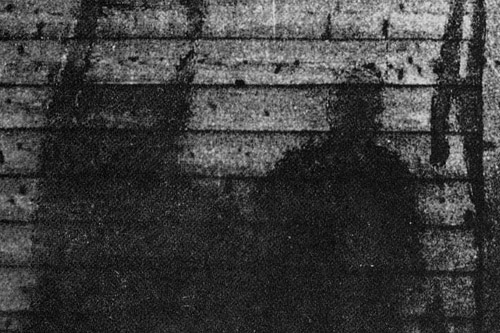
Atomic shadows, Nagasaki
Returning to my present professional concerns my thoughts wandered on to the field of ‘aftermath photography’, the documenting of places and things connected to often awful past events. Places and things which may yet reveal this history under certain circumstances, viewed as it were in the right light, by the right observer. One project I have come across several times consists of photographs of sites of secondary mass graves in Bosnia. The photographs are of relatively unremarkable places, but the subtext is always that at any moment they might divulge the remarkable things they hide, that those who perpetrated and shrouded these crimes will always be at risk of being exposed.
The implication of these images echoes for me the more archaic definition of an aftermath. Not the idea of a static state that follows a terrible event that the word often implies, not the desolate silence of a place permanently destroyed, abandoned, and hidden. Rather the slow process of replacement, renewal, and revealing. At the same time in photography context is as ever so important. Just as these images might reveal their history viewed as I said in the right light, by the right observer, with the right knowledge. It’s equally possible that given the passage of time and the erosion of memory, they might come to viewed as what they are, just places.
Discussion (2 Comments)
Fascinating and insightful Lewis.
I read a piece recently by Mary Beard – observations on Pompeii and the notion of reverence for what are simply casts, yet which are the ‘fingerprints’ of dead people in their last agony. It struck me that we seem ‘comfortable’ with death when it is historically ‘old’ and indeed more so when it is very old such as Tollund Man or Urtzi. I wondered at what point this change in attitude occurs?
I read a piece several years ago in the Observer about Berchtesgaden, Obersalzberg and The Eagle’s Nest, and its history, concerned with the fact that it had been hugely significant to Hitler and exploring the idea that this somehow had ‘tainted’ the view, and that we should not celebrate it because in so doing we align ourselves with evil. (I’m paraphrasing and perhaps wildly out of context!)
The penultimate paragraph in your piece underlines the need for persistent metadata, and an awareness of how the passage of history may change both the historical value of your images, but also the financial value. What may be an image of a simple meadow/site/person may turn out in time to be the vital clue in making up the hidden story of something crucial, something hidden.
Current events in Woolwich, in a matter of minutes, have made the images of a fallen soldier, and his alleged murderers, hugely significant, with a varying ‘value’ depending on your interest. Particularly to the security services.
To finish a rather disjointed set of ‘bits’ – the Poliakoff play ‘Shooting the Past’ with Timothy Spall. Have you seen it? Forget the obvious plot holes and revel in its core premise – that images can tell us stories we never knew existed – and that it needs the fragility of human experience to both realize this and to reveal it – no matter what the cost. A more profoundly moving piece of drama about the power of images I’ve yet to come cross, even with all its flaws. http://en.wikipedia.org/wiki/Shooting_the_Past
Sorry I’ve been really slow and rubbish at replying to this John, I think because theres so much I’ve needed to think about in it.
Love Mary Beard’s writing, and absolutely agree. I had a similar feeling looking at the Lindow Man in the BM recently. Always something I’d seen as a very neutral object but for the first time it struck me as really rather horrible, I was looking at someone’s mutilated, partially decomposed corpse.
There is a strange sense that a space or place can absorb a feeling of what happening there, but it’s difficult to explain how or why. I think ultimately a place is just a place, we bring our own associations. There no doubt countless places where appalling things have been perpetrated but we have simply forgotten, histoy has a very finite memory.
Woolwich, wow. So much to say in terms of perception, memory, how we connect one event with another. I was saying to a friend the other day if this had been a completely random attack, by someone who was for example mentally ill it would have been forgotten so quickly I think. It’s a bit of a weak comparison but look at the Mohammed Saleem, happened shortly before hand, very quickly forgotten by most people partly because of what happened to Lee Rigby, but partly I suspect because it seems so random, so hard to fathom. Better a case where the motives are simple and explicit.
Never seen, sounds fascinating I will look it up. I’ve long felt photographs are somewhat like ink blots or optical illusions, they’re very much about what you bring to them and what you find in them, not so much what they actually show.