
“An invisible line held by the hand of a ghost”
Written by John MacphersonThere were several mentions of dementia in the news yesterday, eerily coincidental, as I was in the middle of writing something about the disease.
First was a theatre production ‘Inside Out of Mind’, which sounds intriguing, described as:
And then shortly afterwards it was announced that Arnold Peters, one of the cast of The Archers had died. His Telegraph obituary noting:
There’s long been a place in the arts for issues around mental illness, for raising awareness, educating and informing, so it makes sense to do the same with dementia, so here’s a thought to consider: Tracey Emin should collaborate with the Alzheimer’s Society. Why Emin? Bear with me please……
I don’t care much for a lot of the conceptual art I’ve seen. Too much of it seems to crave exclusion, the shutting out of those of us who could care less about, or fail to understand, the wordy artist’s statements containing too many big words and too few commas that accompanies it. It’s often work which, shorn of its rigorous intellectual scaffold, gives me the impression it would collapse like a pile of baked beans on sale at the supermarket after one pernickity small child pulls out the wrong tin, too low down.
But I don’t dismiss all of it, there is some conceptual art that’s intrigued me, such as that produced by Tracey Emin. Unlike some of her artistic peers whose work is rooted in some place I am totally unfamiliar with, it always struck me that Emin’s work had some ‘connection’ to the real world where I spend most of my time, an echo of the familiar.
However it would be fair to say that Telegraph columnist Ruth Dudley Edwards isn’t quite so accommodating of Emin, as she proclaims in her piece “She may be a CBE, but Tracey Emin is still naked”:
“I wasn’t going to write about Tracey Emin being made a CBE, since having published a novel (Killing the Emperors) about crass, talentless conceptual art last year, I was taking a holiday from writing about people like her….”
“….(Have a look at this website, where for £300, you too can purchase one of 200 prints of a sketch that could have been created in a couple of minutes by tens of thousands of pencil-wielders. But they are not the Royal Academy’s Professor of Drawing – an appointment that has brought shame on an institution that these days prefers sensationalism to excellence.)”
No mincing your words there then.
However, in a world where its currently somewhat fashionable to dismiss photography and it’s significance I was heartened to read a very touching and insightful comment about photography by Tracey Emin in the Guardian recently, in an introduction to her new book ‘My Photo Album’, one that really struck a chord and made me think:
It struck me that Emin could have been talking about dementia, for it does this too. It takes your memory of who you have been, and how you appeared, and rips it into tiny pieces. It is like sitting in a photo booth and looking into the mirror only to see a stranger gazing back at you. Nothing left to prove to you who you actually are. Well, nothing except the image of you reflected in the memories of family. Memories that, in time, become priceless to them.
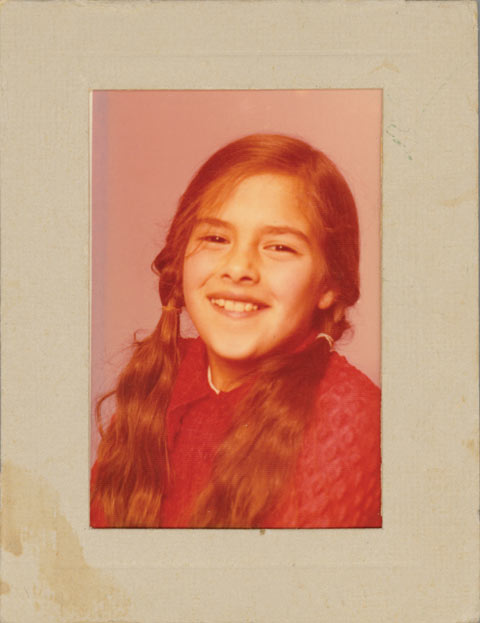
Tracey Emin aged nine © Tracey Emin
I’ve written several times about Alzheimer’s on duckrabbit and the articles have been well received, so last year I offered to share some of my writing with the Alzheimers Society. They were interested: “Please submit to our blog” they said. But I ran into a ‘rights’ problem in their T&C’s:
“3.12 By submitting information to the discussion boards, you grant Alzheimer’s Society a non-exclusive worldwide royalty-free perpetual non-revocable licence to use, distribute, adapt, modify, display, reproduce and transmit such information in any and all media in the manner in whole or in part without any duty to account to you.” (sic)
This surprised me, but I am aware that in order to manage a blog a certain degree of ‘control’ over content is required, and permission is needed in order to undertake the ‘digital duplication’ that of necessity occurs when moving data around, but I’ve not seen it written quite like this. So I queried their need to obtain all rights in submissions from (perhaps) vulnerable people, but in particular when this is undertaken “without any duty to account to you”.
They replied:
“This statement, 3.12, is fairly standard for an online forum and exists to a) protect us from requests for payment for forum content generated by the users and b) allows us to assert our rights over the content if any other party should reproduce the content for their own commercial benefit.”
I queried this justification, noting that:
“The bottom line is that the rights in the material are the property of the contributor and protected as such by The Copyright Act, as an act of their creation by the individual, even when posted on your site. It is therefore disingenuous of you to imply that by ‘stealing’ people’s IP rights that you are somehow offering them more protection from copyright misuse. That is quite simply a ridiculous proposition. I am astonished that you would even consider to offer that reason as justification.”
I continued to press them for an explanation of why they felt this degree of ‘acquisition’ was necessary, but got nowhere. The final comment from the Society’s representative regarding any likely response from their Legal Dept. was:
”I have been unable to get any further response myself so I would consider that the matter is now closed and no further statements will be made. If I do hear anything, then I will let you know but that is quite unlikely.”
I’m not sure why this particular issue upset me. But it did. My dad suffered increasingly from dementia before he died, and my mum currently lives with this dreadful condition. ‘Control’ over the memories of my parents are all I have left of them. These memories are priceless, and if I was to share them with the Alzheimer’s Society I would not expect them to be traded “in whole or in part without any duty to account to you.”
The Alzheimer’s Society do sterling work all over the UK supporting people with this dreadful illness, for which I am grateful, but they could do it just as well without apparently taking control of the only thing many people will have left of their loved ones – their memories. But I have to say, from my considerable amount of previous experience of questioning this kind of rights acquisition, it most likely represents only the attitude of the A.S. Legal Dept and is not something reflected in the ethos and attitude of the individuals within the wider organization.
Statistics about dementia on the Alzheimer’s Society’s site are very sobering, and given the fact that they estimate there will be over a million people in the UK with dementia by 2021, and two thirds of dementia sufferers are women, Tracey Emin may be unfortunate enough to become a statistic.
Emin’s personal art work is challenging, no doubt to its creator too, and I always wondered, as I pondered her various pieces, where does this come from, what is this a response to?
A hint is revealed in Emin’s recollection:
Conceptual art made as a response to the absence of photographs? That’s something to ponder at length.
Maybe Ms Dudley Edwards will now review Emins’ photography book, and be gracious enough to recognize in her photographs the fact that yes this work “….could have been created….. by tens of thousands of pencil-wielders…” but crucially not “…in a couple of minutes….” but requiring a lifetime of experience.
And she may also realize that in sharing this work Emin, perhaps for the first time, is truly naked, revealing her self in that peculiar and unique way that only photographs can achieve.
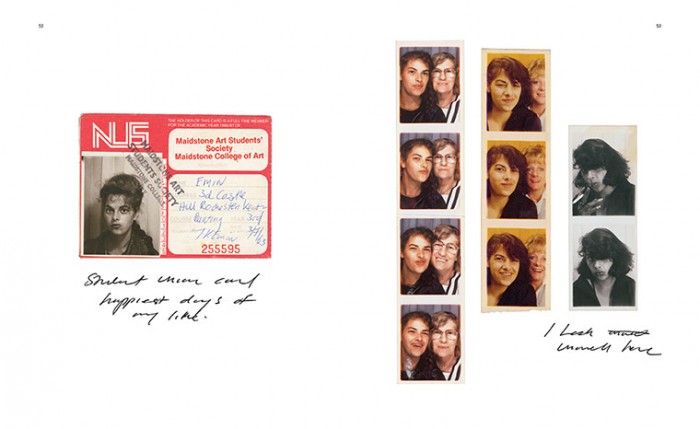
Photo Booth © Tracey Emin
Never mind the other work she’s produced, Emin’s ‘photo album’ may turn out to be her most significant work yet precisely because her simple image collection is something we can all recognize ourselves in, identify with the line created by the living of our own lives, scrawled by we “tens of thousands of pencil-wielders”…..and drawing as Emin herself so eloquently describes it…“An invisible line held by the hand of a ghost, moving from one world to the next.”
The Alzheimer’s Society might benefit greatly from collaborating with an artist of the status of Emin to raise awareness of this awful condition. They should take note of the value Emin places on the memories of her younger self, and the fact she has been able to eloquently illustrate in a few sentences, albeit obliquely, the damage that dementia can do, and in a profoundly moving way that we can all understand. No ‘exclusivity’ nor conceptual posturing here:
And in the final line of her final paragraph provides a touching and heartfelt observation that should resonate with all of us, and to which I think we would all aspire:
I sincerely hope she does have the joyous experience of contemplating her younger self when she is old, sees the line she’s drawn from past to present, and is able to celebrate who she has become, but crucially recognizes who she once was.
Memory is a rare thing: it’s something we must hold close and personal, but also something which, if it is to have value, we must of necessity willingly share. But it is not something any of us should ever have taken from us.
( Tracey Emin, My Photo Album, is published by FUEL, price £19.95.)

Author — John Macpherson
John MacPherson was born and lives in the Scottish Highlands. He trained as a welder in the Glasgow shipyards, before completing an apprenticeship as a carpenter, and then qualified as a Social Worker in Disability Services. Along the way he has cooked on canal barges, trained as an Alpine Ski Leader & worked as an Instructor for Skiers with disabilities, been a canoe instructor, and tutor of night classes in carpentry, stained glass design and manufacture, and archery. He has travelled extensively on various continents, undertaking solo trips by bicycle, or motorcycle. He has had narrow escapes from an ambush by terrorists, been hit by lightning, caught in an erupting volcano, trapped in a mobile home by a tornado, kidnapped by a dog's hairdresser, rammed by a basking shark and was once bitten by a wild otter. He has combined all this with professional photography, which he has practised for over 35 years. He teaches photography and acts as a photography guide & tutor in the UK and abroad. His biggest challenge is keeping his 30 year old Land Rover 110 on the road. He loves telling and hearing stories.
Discussion (2 Comments)
John
I have written a comment for you on your website about Alzheimers.
(well more like a youg essay!)
Cheers
Val
Thanks Val.