
Are you just the photographer?
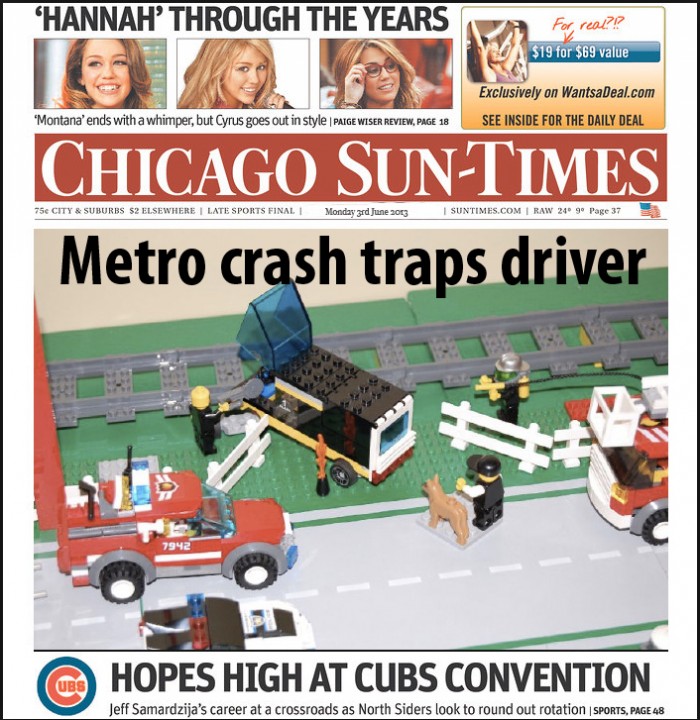
Written by John MacphersonThey think multimedia is simple………………
I just wish that the people who control our futures did the same.
Scott Strazzante commenting on the layoff of the entire Chicago Sun-Times photography staff.
Maybe this is a glimpse of what the print media’s future look like……
All images © their respective authors.

Author — John Macpherson
John MacPherson was born and lives in the Scottish Highlands. He trained as a welder in the Glasgow shipyards, before completing an apprenticeship as a carpenter, and then qualified as a Social Worker in Disability Services. Along the way he has cooked on canal barges, trained as an Alpine Ski Leader & worked as an Instructor for Skiers with disabilities, been a canoe instructor, and tutor of night classes in carpentry, stained glass design and manufacture, and archery. He has travelled extensively on various continents, undertaking solo trips by bicycle, or motorcycle. He has had narrow escapes from an ambush by terrorists, been hit by lightning, caught in an erupting volcano, trapped in a mobile home by a tornado, kidnapped by a dog's hairdresser, rammed by a basking shark and was once bitten by a wild otter. He has combined all this with professional photography, which he has practised for over 35 years. He teaches photography and acts as a photography guide & tutor in the UK and abroad. His biggest challenge is keeping his 30 year old Land Rover 110 on the road. He loves telling and hearing stories.
Discussion (11 Comments)
Scary times, John.
Aye Tony – even scarier than you think if you believe this stuff:
“Professional photographers constantly battle over which DSLR is the best for taking photographs. Cannon, Nikon, and Epson are all great choices and well designed cameras. The perks of using the iPhone camera instead of a DSLR are intriguing. The iPhone allows photographers to take pictures of objects that they would usually pass by. They allow people to capture moments so that they may be turned into memories. Trash cans, busy streets, and even people turn into embodiments of the world around us. Now that is pretty cool.”
Even people!!!
Aye Stan. “Even people” – those embodiments of the world around us. Think I’ll dump my Canons and get an old s/h iPhun or whatever.
There has been some good stuff done with iPhones, e.g. Michael Christopher Brown’s work in Libya and Ben Lowy’s in Afghanistan, but they are pro togs who know what they’re doing. Getting any Joe or Joanne that works in the office to go out and come back with quality photos (irrespective of what gear they’d use) is just such an asinine idea on so many levels. Would the paper do the same to the print journos, i.e. have them all sacked and have the photographer’s do the writing? No, it would be an equally bad idea. I guess this is the result when profit is the overwhelmingly primary motive.
Someone else did some incredible street work with one also, but you’re exactly right, tonemeister. People have seen the results pros can squeeze outta these things and it becomes the de facto expectations of what everyone can capture.
It will be interesting to see how long it is until the pendulum swings the other way. Once you hit the bottom of the barrel the only way left to go is up.
I was deeply saddened when news of the Sun-Times decision came through in the UK. I wasn’t entirely surprised though. The onslaught of social media and photography sharing platforms has made cheap/free photography of reasonable quality incredible accessible. Equally, higher bandwidths and mobile technology have made online video streaming almost a given. It’s another reason to evolve.
Hi Willie. You’re right. But. I wonder how long it will be before some of the ‘givers for free’ realize the value of some of the work they voluntarily hand over and which occasionally generates significant revenue through syndication, and they want a slice of that pie.
Basing much of your business plan on something that appears to be ‘free’ is somewhat short-sighted in my opinion. It may not be free forever.
Alex Garcia on the Chicago Tribune makes some good points here.
Photojournalism is a dead (since a few years): the way journalism is produced and consumed has changed forever. Frankly, it’s sad and somehow pathetic to see photographers trying to deny the reality. When photojournalism still made sense and was a viable profession, photographers didn’t need to beg for dignity — nor needed to continuously re-affirm that their craft was “still alive”. Time to move on, looking for new horizons!!
Thanks very much for the reply wakeup. Which is one I disagree with in many respects.
Photojournalism is not dead. Its alive, well and kicking hard if the quality and range of work I see online is anything to go by. What is dying is the traditional method of delivery (and payment) through print media. Spot news photography may be gasping its last breaths as on-the-scene-iphoners capture breaking moments as they occur. But long-form, in-depth, insightful and committed work is still being done, and needing to be done. And there are many people doing it, and some of them finding novel and different ways of funding it, and making it pay.
I dont see anyone “begging for dignity”, I see people with dignity, skill and ambition who know the value of the work they (can) do, fighting against a perception that what they do is ‘easy’ – the ‘hey its digital, all you need is a finger to push a button’ mentality. Its not that easy. It never has been, and never will be. It’s dead easy to copy, paste and distribute it, but the creation of it is not to be confused with that ease of delivery. Just because you have ‘a finger’ doesn’t make you a photojournalist anymore than it makes you an orchestral conductor, or a sniper.
The ‘new horizons’ you mention are out there, in multimedia, on the web, in a variety of shapes and forms, even in print. Some of which opportunities are not yet fully integrated into the new platforms that are being developed. Heck the furore over the NYT ‘Snow Fall’ and how it was a ‘glimpse of the future’ which was one quote I read about it, was something I disagreed with, I thought it an excellent piece of storytelling but it wasn’t a glimpse of the future, it was a glimpse of now. Simply using the tools we’ve had for ages and did not use properly. What will we be able to do with really new tools?
These are undoubtedly hard times for many people, but that’s what happens when disruptive technology emerges, which has happened numerous times through history. Its not that long since a time when your message to me might have been written on a slate, carried by a guy on horse and hand-delivered, before the carrier pigeon sounded the death-knell of the horse-trainer, and saw the rise in the fortunes of the pigeon trainers.
Times change, markets evolve. People with skill will find their niches and exploit them using whatever tools work for them. And even invent new tools.