
Return of the Sun
Written by John MacphersonThe north of Scotland is surprisingly ‘far up’. Where I live is about 57.5 degrees north – that puts us on the same latitude as Gothenburg in Sweden, and going left, through both Hudson Bay in Canada and Kodiak Island in Alaska.
And this has been a long winter. It snowed in November. And in December. And January, and off and on until a week ago – the last week in May. But the sun is higher now, and sunset last night, at well past 9pm was glorious with the sun sinking only just below the horizon but the night not really growing dark. A glorious golden colour persisted until well after midnight, and dawn started to break at 3.30am. And there is still another three weeks until the summer solstice.
Some scholars think our ancestors might have been strongly influenced by the movement of the sun and moon, and cite as evidence of their reverence the standing stones they erected in various places, but particularly on the Orkney Isles at Brodgar and at Calanais (Callanish) on Lewis in the Western Isles.
The Ring of Brodgar is astonishing – set on a small hill surrounded by water it rewards those who wish to stay up beyond midnight on a summer night, or rise at 2.30am for sunrise, with spectacular alignments of monoliths and sun.
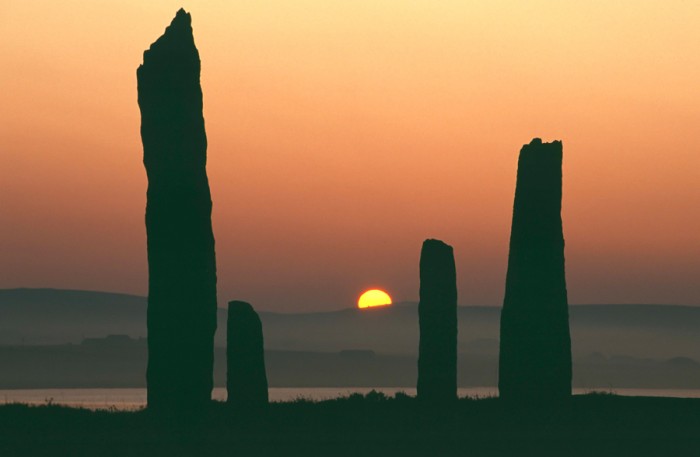
Ring of Brodgar © John MacPherson
Calanais on the Isle of Lewis has a different atmosphere, hard to pin down, but as is the way of these amazing places…well…just different, and to my mind many of the stones resemble cloaked figures, but not male, definitely not male. These are certainly female figures, changing in profile as you move around them, shape and form appearing and disappearing, shifting and changing with perspective, light and shade. A nice thought, that perhaps our ancestors worshipped women THIS much.
The Calanais stones are a compact grouping, more so than Brodgar, but it is widely regarded as being the second most important group of standing stones in the world, and often called “The Stonehenge of The North”. Curiously, it is also the only cross-shaped grouping of stones in the world.
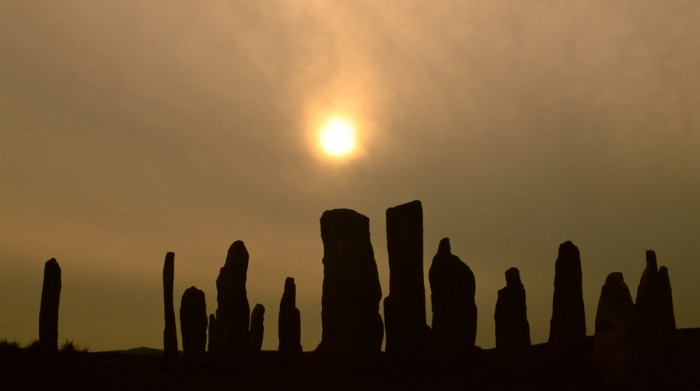
Calanais, Isle of Lewis © John MacPherson
Both of these sites are more than 4000 years old, and there has been much debate about whether the stones placement follow astronomical alignment, many scholars proclaiming this to be the case; but others are skeptical and suggest the possibility of the stones having shifted or being deliberately moved over the many thousands of years they’ve existed on each site makes calculations of such alignment impossible. Various other theories exist: that the stones were meeting places, or perhaps places of worship, maybe even sites for honouring the ancestors. All are plausible.
Me?
I think it’s all about light.
Many of those skeptics may not have lived in the north, may not have spent long dark winters and their desperately short days before welcoming the return of spring and the promise of sun, breathing a sigh as the air warms again, as verdant growth bursts forth. They should visit Brodgar on a day of crystalline light, and look around at fields ready for harvest, houses dotting the landscape with all their inhabitants filled with a sense of purpose – making the most of the light-filled days. But preparing for the winter, and the approaching dark, the stoneshadow dark that spins an arc around each stone to remind them of what draws near. Then perhaps they’ll understand.
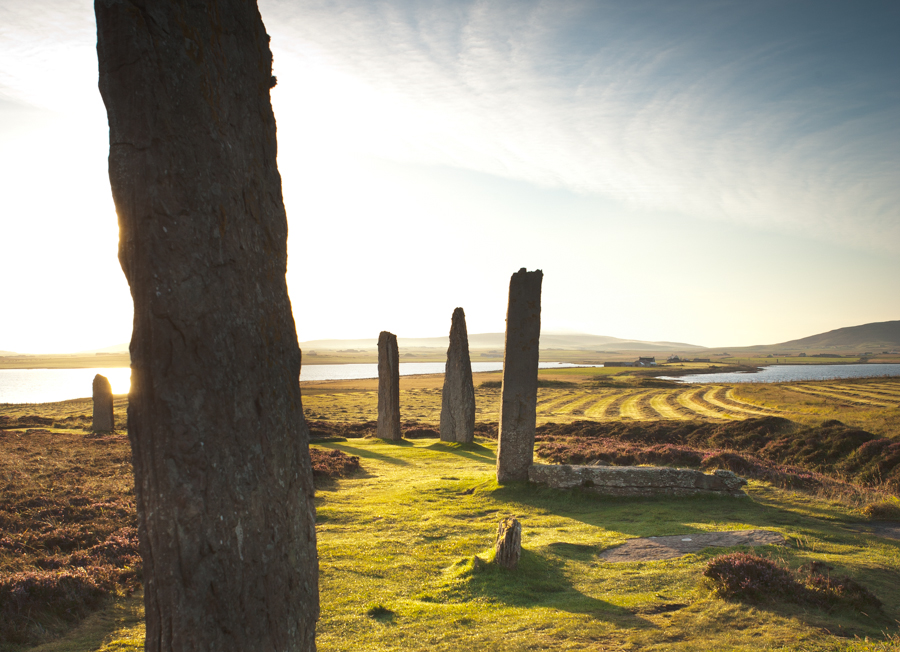
Brodgar © John MacPherson
And in recent years intruding into all of this is the effect of climate shift: I’ve been photographing people working on the sea and with the land here in Scotland, who are feeling the impact of changing weather patterns and the unexpected effects it is having on their work and incomes, forcing changes in work patterns and expectations of what each successive year might bring.
But go further north, towards the arctic circle, and the change of seasons becomes even more significant. Winter is several months of darkness, before the first glint of summer sun appears, heralding the return of the light. But the effect of climate shift is even more acute in the arctic as ice that once was almost permanent now melts and traditional ways of life are forced to adapt.
All of which preamble brings me to ‘Return of the Sun’ – a short video portrait of a modern Inuit family, by Glen Milner and Ben Hilton. Beautifully shot and edited, the film follows a fisherman and his son as they are forced to adapt to changes affecting the Arctic environment, as climate shift impacts on their surroundings and their day to day lives. The sound design is very beguiling, and the atmosphere achieved is palpable.
This is an impressive and quite beautiful piece of work. The voices of the father and son will echo in your mind for a long time after it ends.

Author — John Macpherson
John MacPherson was born and lives in the Scottish Highlands. He trained as a welder in the Glasgow shipyards, before completing an apprenticeship as a carpenter, and then qualified as a Social Worker in Disability Services. Along the way he has cooked on canal barges, trained as an Alpine Ski Leader & worked as an Instructor for Skiers with disabilities, been a canoe instructor, and tutor of night classes in carpentry, stained glass design and manufacture, and archery. He has travelled extensively on various continents, undertaking solo trips by bicycle, or motorcycle. He has had narrow escapes from an ambush by terrorists, been hit by lightning, caught in an erupting volcano, trapped in a mobile home by a tornado, kidnapped by a dog's hairdresser, rammed by a basking shark and was once bitten by a wild otter. He has combined all this with professional photography, which he has practised for over 35 years. He teaches photography and acts as a photography guide & tutor in the UK and abroad. His biggest challenge is keeping his 30 year old Land Rover 110 on the road. He loves telling and hearing stories.
Discussion (6 Comments)
Another nice article, John. 57.5° made me go check it on Google Earth—puts Kinlochewe close, a place I’ve been.
Thanks Farhiz. Aye just across the way from Kinlochewe – spent a lot of time there myself on various projects for SNH the environment agency who manage the whole area – it’s a National Nature Reserve. Lovely part of the country, and pretty wild.
Lovely film. Reminds me of the work of Ragnar Axelsson
Hello Andrea – yes it is. And does! I drool over RAX website regularly. Great stuff.
Great article! Thanks.
You’re welcome!