
History, place and people
Written by John MacphersonA few years ago I wandered over a remote hillside above a secluded sea loch on the west coast of Scotland, one that few people walk into given the rough terrain, preferring the ease of access by sea. My own grandfather had been born not far away, in an unremarkable low thatched stone house, now overgrown and consumed by vegetation. I’d been up this particular loch by boat once, several years previously and noticed a lone corrugated iron roofed cottage set back on the lower slope of the hill, obviously abandoned, but I didn’t visit it. Now on foot I decided to detour over and have a look. It was a time capsule. Old clothes still hung on a door, a tablecloth, stained and mouldy, covering the table and held down by the dusty plates lingering on top, chairs stood pushed back waiting for re-use, and ‘stuff’ of all sorts was scattered around. People had got up after some meal, and simply left. Locking the door and never returning.
Such ruins are not uncommon in many parts of the highlands and islands, but nowhere more so than the Western Isles, for a variety of reasons. Photographer Ian Paterson explains some of these reasons in an excellent interview on The Island Review where he discusses a photographic project he’s undertaken with ex-Buzzcocks drummer John Maher (who now lives on Harris).
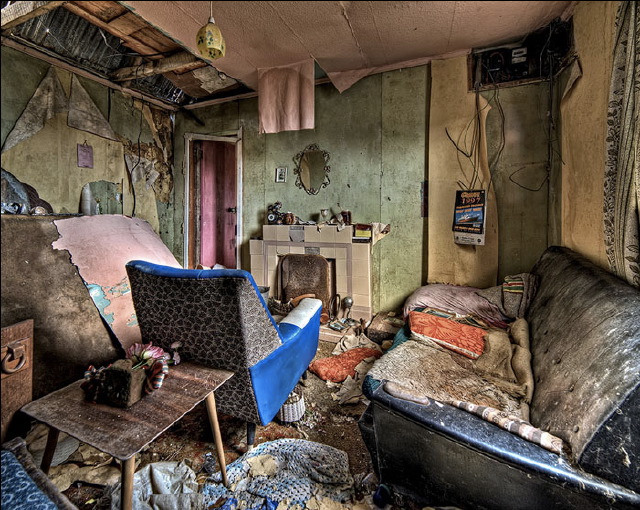
Blue Chair, Isle of Harris © John Maher
But theirs is no ‘ruin porn’ – exploitative images sharing only the common theme of decay, all ‘surface’ and lacking ‘depth’ – but rather an elegiac and wistful glance backwards into the lives of the families that once inhabited these homes. Paterson and Maher have not only photographed many properties, but painstakingly sought out former residents or their descendents and teased from them their stories (excerpt from The Island Review):
The stories of the lives of those who’ve lived in these abandoned houses are important. Their presence in these places made a difference, they contributed to the community, and it’s important to remember also that their absence makes a difference now. Today’s communities exist upon the foundations they laid down. If we can listen to them the stories of their presence can weave themselves through the fabric of our own lives. They may lead us to places we may not otherwise visit, and feel things in a way we may not otherwise have felt. And for all their abandonment they leave the rich legacy of their stories for us all to heed.
John Maher and Ian Paterson will have their exhibition A’ Fàgail na Dachaigh / Leaving Home: an alternative view of the Outer Hebrides running from Saturday 9th November until Tuesday 31st December 2013 at An Lanntair, Stornoway.
What better excuse could you have for visiting the Western Isles?

Author — John Macpherson
John MacPherson was born and lives in the Scottish Highlands. He trained as a welder in the Glasgow shipyards, before completing an apprenticeship as a carpenter, and then qualified as a Social Worker in Disability Services. Along the way he has cooked on canal barges, trained as an Alpine Ski Leader & worked as an Instructor for Skiers with disabilities, been a canoe instructor, and tutor of night classes in carpentry, stained glass design and manufacture, and archery. He has travelled extensively on various continents, undertaking solo trips by bicycle, or motorcycle. He has had narrow escapes from an ambush by terrorists, been hit by lightning, caught in an erupting volcano, trapped in a mobile home by a tornado, kidnapped by a dog's hairdresser, rammed by a basking shark and was once bitten by a wild otter. He has combined all this with professional photography, which he has practised for over 35 years. He teaches photography and acts as a photography guide & tutor in the UK and abroad. His biggest challenge is keeping his 30 year old Land Rover 110 on the road. He loves telling and hearing stories.