
Watching the Birdie
Written by John Macpherson

Hi RSPB – I note that you have changed the Terms and Conditions of the Nature Photography Competition, and that they are now less draconian than previously, and welcome the fact that you’ve gone some way towards respecting creator’s rights. Thank you.
However I followed the link at the bottom of the Competition page which clearly states your Terms and Conditions for participation in your website and what you describe as the ‘Community’, and which clearly states the Terms which participants agree to be bound by. I have to say I was more than a little dismayed by the small print, some of which I reproduce here:
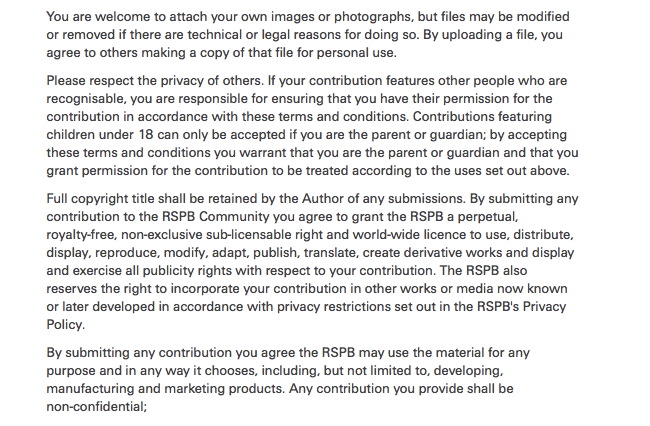
You are certainly not the only organization to have these ‘rights grab’ terms, but like all the others I believe you are taking advantage of people who may not know any better, and who may not read the small print. Of course some may read these terms and understand them and not be bothered, but not all people do.
In my opinion you are directly disadvantaging not only ‘amateur’ contributors but also professional photographers (some of whom are represented by your Picture Library). These are individuals who must fund their shoots personally. You are forcing down the market value of images, and the resulting fees these photographers may earn, by blatantly taking contributor’s rights in their images, which gives you a no-cost asset that you can monetize. You may even opt to use a ‘free’ image over a professional’s image and save the royalty fee you would have had to pay the professional. It’s a process of attrition.
As an organization, you exhort your members to protect the environment for nature, yet ironically the market for imagery, the photography environment, is one you seem to have no respect for. This is not the first ‘competition’ of this sort you’ve held, with rights grabs at its core, you’ve run several of them over the years.
Why does this matter? Why am I bothered?
Well, as a professional photographer I am affected in the widest sense as I see reproduction fees being driven down, across the industry but particularly in the natural history market. However as a teacher of photography and one who works with young people on a regular basis, encouraging them to appreciate nature through photography, and advises them on career routes and options, I find your attitude to the photography environment short-sighted at best.
I have a professional involvement with Falmouth University’s Marine & Natural History Photography Degree course, a course that I’d have to say is probably the best of it’s type in the UK, if not Europe. Its graduates are sought after, and several are currently working in high profile positions across the industry. I’ve spoken with many of these young people and they are all keen to earn a living in their chosen profession and at the same time make a difference for nature.
However the market into which these young people will graduate is a difficult one to survive in financially because of the ways that the industry has evolved. If these hugely gifted and capable young people cannot earn a living in their chosen field of natural history image-making and decide to leave the profession for something else, we all lose. And ultimately you, the RSPB, lose. You rely on imagery to communicate, both still and moving, and without a pool of talent as represented by the likes of Falmouth’s, and other University’s graduates, your ability to ‘tell the stories of nature’ will be seriously impaired.
In many respects RSPB sets the bar against which other environmental charities are measured. You do remarkable work across the UK and have a committed and respected cohort of staff, many of whom I’ve worked with over the years, and have the utmost respect for. It would be heartening to know that RSPB at a corporate level had similar respect for we image-makers, whether amateur or professional. You have huge influence in the UK and I’d respectfully suggest you’re in a key position to set the standard for image acquisition from your supporters, in a way that respects creator’s rights and which actively encourages a market in which the young filmmakers and photographers emerging today can flourish.
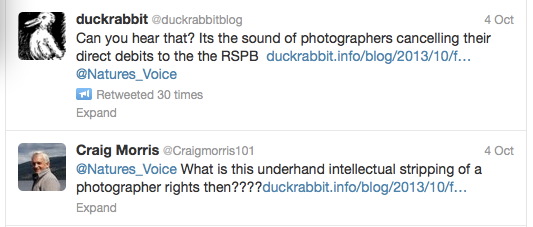
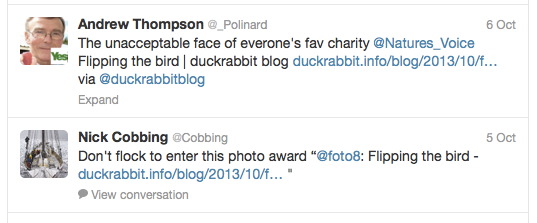
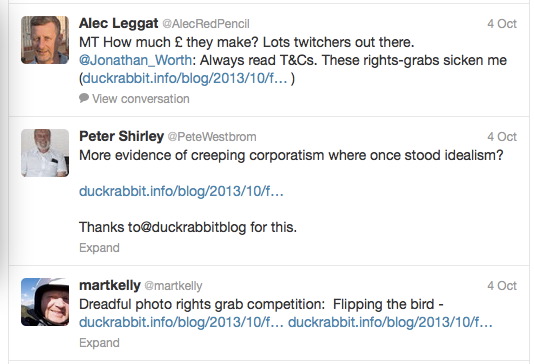
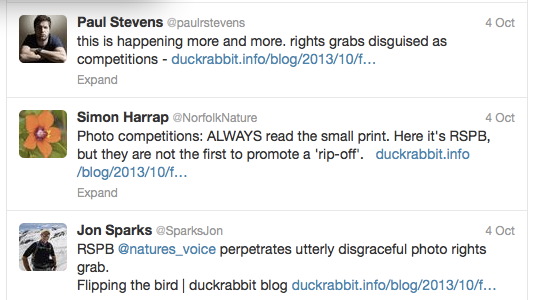
It’s a common misconception that ‘free’ images have no cost. That’s so far from the truth, as recent tweets regarding your competition T&C’s show the price you’ve paid:
Images matter. And your image matters too. And only you can improve it.

Author — John Macpherson
John MacPherson was born and lives in the Scottish Highlands. He trained as a welder in the Glasgow shipyards, before completing an apprenticeship as a carpenter, and then qualified as a Social Worker in Disability Services. Along the way he has cooked on canal barges, trained as an Alpine Ski Leader & worked as an Instructor for Skiers with disabilities, been a canoe instructor, and tutor of night classes in carpentry, stained glass design and manufacture, and archery. He has travelled extensively on various continents, undertaking solo trips by bicycle, or motorcycle. He has had narrow escapes from an ambush by terrorists, been hit by lightning, caught in an erupting volcano, trapped in a mobile home by a tornado, kidnapped by a dog's hairdresser, rammed by a basking shark and was once bitten by a wild otter. He has combined all this with professional photography, which he has practised for over 35 years. He teaches photography and acts as a photography guide & tutor in the UK and abroad. His biggest challenge is keeping his 30 year old Land Rover 110 on the road. He loves telling and hearing stories.
Discussion (4 Comments)
As someone who has been with both party’s both training with John in collage which was a great few weeks of learning and fun. I must say would never miss the Chance to do it again and someone who volunteers with the rspb still I would stay well away from this competition even with the new terms after last week as John said back in collage always read the terms before entering any competition which iv done even since which iv seen most are all about rights grabbing with uneven prizes for the work of the photographer’s that enter there hard and time consuming wildlife pictures
Thanks John. Always good to hear a younger voice on here! Yes, taking good wildlife images is not an easy task, so why should you give them away for someone else to make money from them?
Yes very true I no for a fact they have a very limited library when it comes to stock photography for web use and ect and would rather a much more straight forward competition where rules where much more clear God as a charity no one minds the odd image in a calender but make it worth are time with the shop store selling binoculars at 200 to 300 pounds a go or even a bird table with 6 months of free foods I’d post an image my self as long as they use image as limited use
Absolutely. I have no problems with competitions provided they are upfront about whats going on and actually offer decent prizes. But offering you a copy of your own image as a ‘fantastic’ prize is stretching credibility!