Family
Written by John MacphersonIf you’ve read any of my recent posts you’ll know that there has been a constant throughout – that of ‘family’.
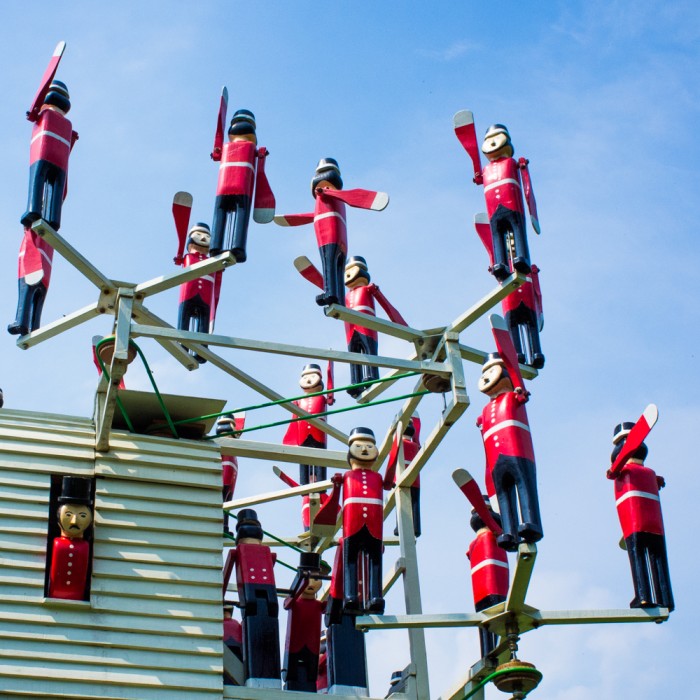
We’re all the same (almost) © John MacPherson
It’s a word we use often and perhaps less often stop to consider what it actually means. There’s a few definitions: a unit consisting of parents and children; and then there’s the wider meaning – all the descendents of a common ancestor. But there is also an informal interpretation where the ‘family’ is a group of disparate individuals connected through their (sometimes criminal) enterprises, such as the mafia, although also perhaps with strong blood relationships to underpin it.
Coincidentally just a week ago I was privileged to have some of my documentary work on rural Scottish island fishermen featured in Rear Curtain (Issue 5). It’s work that is important to me for several reasons – the people featured are ‘my people’, rural Highlanders, but they are also families whose determination to uphold their (island) traditions and wrestle a living from their harsh environment in collaboration with each other is something I admire greatly. These are people who are not only located on the physical edge of my country, but teetering on the economic margins too. This is photographic work that has been rejected by several major Scottish newspapers and magazines, for reasons that escape me. So I was pleased to see it finally in print and gaining a wider audience.
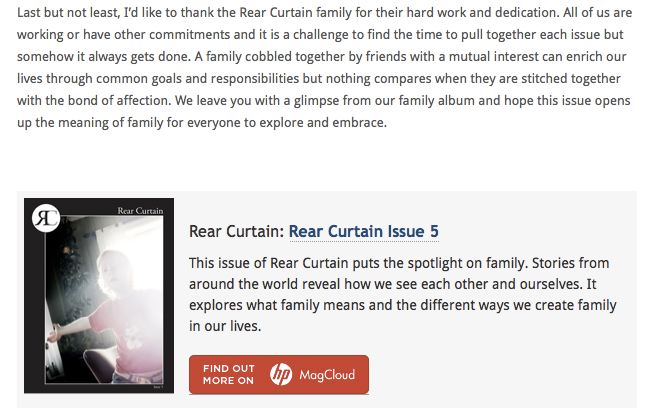
Rear Curtain Issue 5 Editor’s Note © Sabrina Henry
But what pleased me even more was to have it included in a collection of work in Rear Curtain under the theme of ‘Family’. In this same issue is an interview with, and images from Jim Mortram: gritty, insightful and powerfully moving collaborative work with his subjects, but again a group of people on the margins, however this time not so much geographically marginalized, more socially and economically disadvantaged. But crucially people with whom Jim feels a sense of kinship.
But the article in RC5 that most moves me is ‘All the Same, but Different’ by Hilde Mesics Kleven. I’ve worked hands-on with people with Down Syndrome for almost two decades in Social Work and watched families suffer, fail, try again, and sometimes triumph as they try to accommodate a child with Down Syndrome. Their struggles are often not so much against the Syndrome, but the social systems we rely on and which too often exclude those whose needs are more complex and challenging, which forces such individuals to the precarious margins of our communities. Hilde’s work shows the riches that can accrue when they are put at the centre, and may flourish.
And as the icing on the cake, RC5 includes an interview with William Albert (Bill) Allard, a photographer whose work I’ve admired for many many decades. His ability to ‘disappear’ as a photographer, and thus be able to capture little insightful moments of other’s lives is uncanny. There’s a wonderful paradox in this – that the very ability to ‘disappear’ depends entirely on one’s ‘presence’ and unwavering willingness to be wholly involved in the lives of others.
There is much much more beautiful, insightful work in RC5, from Mallory Benedict, Brian Miller, and Mark Krajnak, and to have my own work appear in the same issue as such esteemed photographers is, simply, an honour.
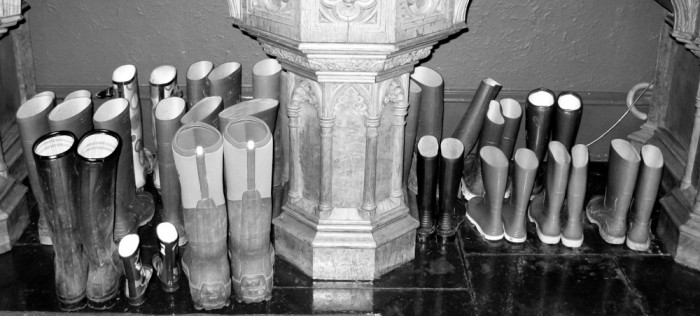
One big family © John MacPherson
My own ‘family’ has taken a few knocks of late, and despite it all, perhaps even because of it all, I’ve clutched even tighter to my camera. Because ‘outside’ of the sphere of immediate family I’ve realized that through my use of this very peculiar device, the camera, a wider ‘family’ has been ever present. A ‘mafia’ of sorts, whose shared love of imagery, and image-making has united us. Your occasional, gentle enquiries about ‘how are things?’ with me, ‘how’s your partner?’ and ‘how is wee William, is he coping ok?’ have been both heartening and often uplifting, often arriving just at a moment when most needed.
Photography is a strange strange craft. The camera can legitimize intrusion into circumstances, and the lives of others, in a way no other device can. But I’ve realized over the years, and had it underlined over the last few months, that it’s a two-way street, that BEING a photographer opens you to an unbidden allegiance with a disparate group of people for whom the notion of ‘family’ is deeply engrained, and who, by some strange alchemical process I can’t even begin to guess at, just ‘know’ when you need a lift, a word, and sometimes a bit of space. We are fortunate people to share this. So, to all of you, and you know who you are, thank you: for taking the time to ask, and to share. It has not gone unnoticed, and it will not go unrewarded.

Author — John Macpherson
John MacPherson was born and lives in the Scottish Highlands. He trained as a welder in the Glasgow shipyards, before completing an apprenticeship as a carpenter, and then qualified as a Social Worker in Disability Services. Along the way he has cooked on canal barges, trained as an Alpine Ski Leader & worked as an Instructor for Skiers with disabilities, been a canoe instructor, and tutor of night classes in carpentry, stained glass design and manufacture, and archery. He has travelled extensively on various continents, undertaking solo trips by bicycle, or motorcycle. He has had narrow escapes from an ambush by terrorists, been hit by lightning, caught in an erupting volcano, trapped in a mobile home by a tornado, kidnapped by a dog's hairdresser, rammed by a basking shark and was once bitten by a wild otter. He has combined all this with professional photography, which he has practised for over 35 years. He teaches photography and acts as a photography guide & tutor in the UK and abroad. His biggest challenge is keeping his 30 year old Land Rover 110 on the road. He loves telling and hearing stories.
Discussion (2 Comments)
Thank you John, for your contribution to this issue. It was a perfect fit for the stories we wanted to bring together under the theme of family but more than that, we felt it was a story that should be shared. There is much to admire in the life of these rural Highlanders and even more to learn from their commitment to family and tradition.
Aye, their ‘place’ may seem idyllic but it’s far from easy. We might yearn for some place in the world that’s so ‘simple’ but in truth their existence is far more precarious than many city dwellers.