
That other world wide web
Written by John Macpherson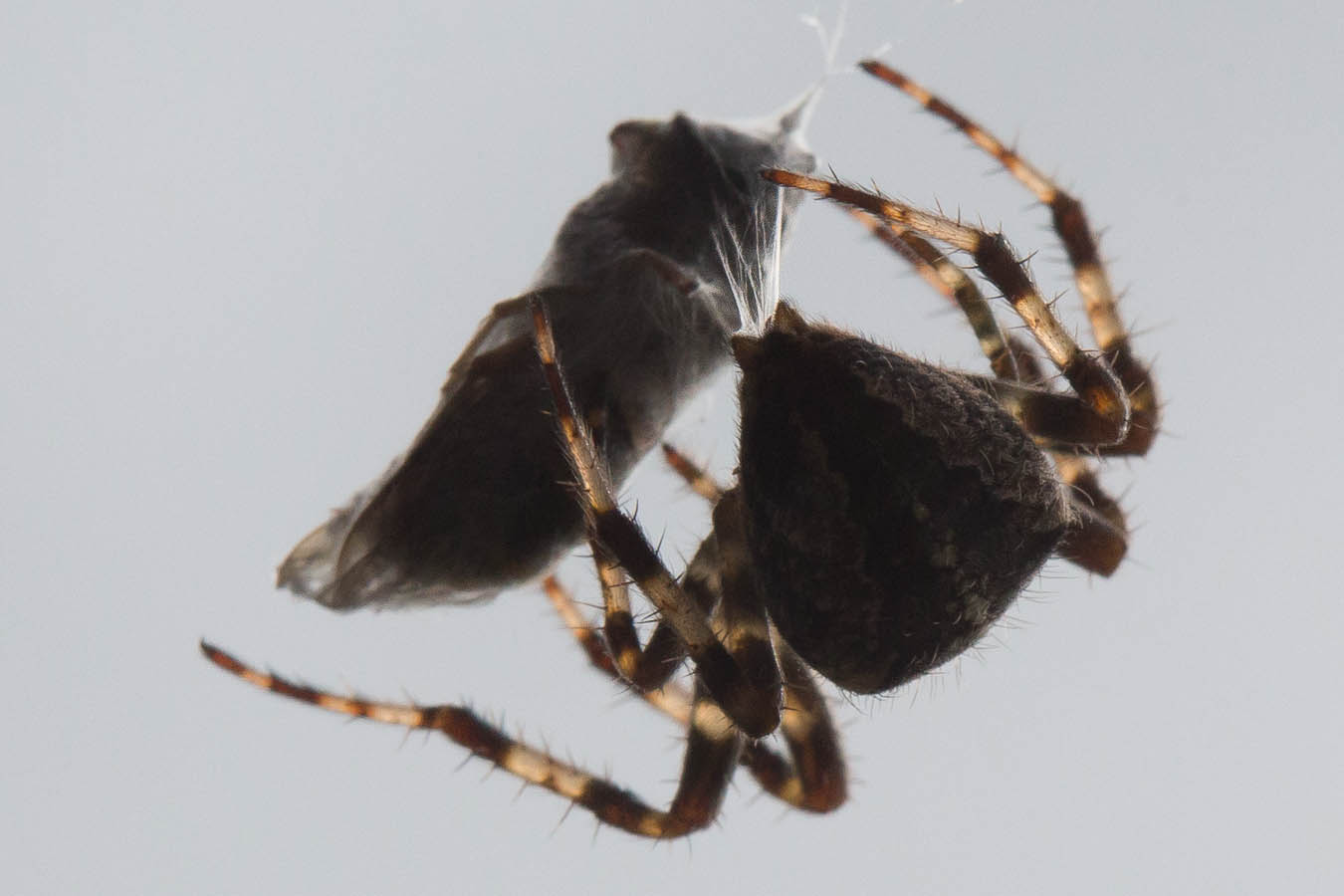
Spider does the business on a careless wasp © John MacPherson
What they mean could be more simply put as: the silk proteins go from being soft ‘stuff’ to harder ‘stuff’ by the change in pH as they travel through the spider’s glands. Why? To prevent the spider getting ‘constipated’ with its own silk. Clever.
And now that they understand the mechanism and process behind it, if scientists can imitate and synthesize this material, it could be used for all manner of novel applications. The spider in my picture above simply used it as nature intended: to wrap its wasplunch for later.
Read more in Plos Biology: Carbonic Anhydrase Generates CO2 and H+ that Drive Spider Silk Formation Via Opposite Effects on the Terminal Domains.

Author — John Macpherson
John MacPherson was born and lives in the Scottish Highlands. He trained as a welder in the Glasgow shipyards, before completing an apprenticeship as a carpenter, and then qualified as a Social Worker in Disability Services. Along the way he has cooked on canal barges, trained as an Alpine Ski Leader & worked as an Instructor for Skiers with disabilities, been a canoe instructor, and tutor of night classes in carpentry, stained glass design and manufacture, and archery. He has travelled extensively on various continents, undertaking solo trips by bicycle, or motorcycle. He has had narrow escapes from an ambush by terrorists, been hit by lightning, caught in an erupting volcano, trapped in a mobile home by a tornado, kidnapped by a dog's hairdresser, rammed by a basking shark and was once bitten by a wild otter. He has combined all this with professional photography, which he has practised for over 35 years. He teaches photography and acts as a photography guide & tutor in the UK and abroad. His biggest challenge is keeping his 30 year old Land Rover 110 on the road. He loves telling and hearing stories.