
The economy of ignorance
Written by John MacphersonPat Pope was right. That’s my stance.
Pat is a photographer, and he was asked by the band Garbage to give them some of his work for free. Pat was unhappy with the ‘deal’ on offer, having apparently also had his work used without permission by the band previously, so aired his dismay publicly. You can read his response here: link
Garbage responded ‘formally’ here: link to Facebook
This thread is not about whether Pat was right or wrong; Pat made a professional judgment and on the surface it seems a reasonable decision to make.
No, what this thread is about, is ignorance.
Someone called Gabriela claiming to be speaking for Garbage responded to Pat Pope directly, in the responses to his blog post. You can judge for yourself what the tone of her comment displays:
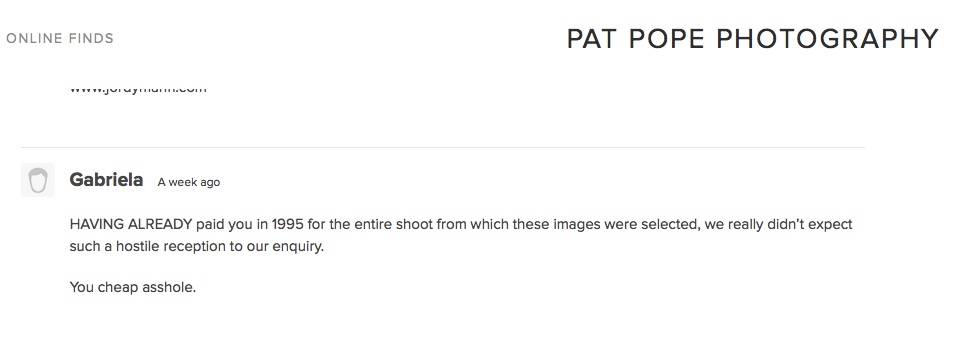
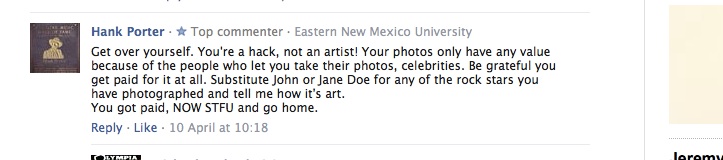
Apart from Gabriela’s very forthright response, what has really surprised me are the uninformed comments this affair has elicited, and specifically the fact that some of them come from apparently well-educated people speaking on behalf of educational establishments: so here’s Hank from Eastern New Mexico University‘s take on the matter on HuffPost: (link to thread)
Or how about Zac Brewer’s thoughts, speaking eloquently on behalf of Hult International Business School in Cambridge, Mass.: (link to thread)
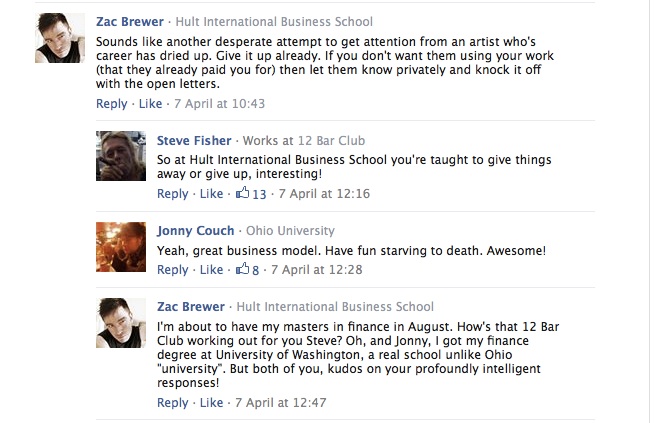
Yes, Zac is studying finance. How business works, supply and demand, payment, all that fiscal stuff you need to know in order to turn a profit.

So Zac, and anyone else who finds this concept of ‘payment for photography’ hard to follow. It’s called licensing – the ‘owner’ of the work, for a fee ‘licenses’ the user on a per-use basis. Repeat use for another, different, project requires repeat payment. Simple.
Oh, sorry, it’s still too hard to understand?
Ok try this: I buy a Garbage album on vinyl in 1995. They re-release that same album in 2005 on CD, so they give me it for free if I ask them. Right?
No they don’t.
I paid for the right to listen to their music delivered to me on a large piece of plastic using a needle, that’ll be ‘licensed for delivery on vinyl’. Now that I want to listen to it using a beam of light, I need to pay again. That’ll be…yes you’re catching on fast…’licensed for delivery on CD’.
And if I want to see them play the same music live I get in to the gig for free, after all, I’ve paid for the music twice now? No, I need to pay again, that’ll be ‘licensed for live delivery’. It’s how (the music) business works.
Oddly enough it’s just like the way Business School works. The School licenses specifically created teaching material (made by very talented people in the educational publishing business) and employs tutors to deliver it. Students pay a fee to attend, and as part of that deal the material is ‘licensed’ to them, for the purpose of their education.
Not hard to understand really, is it.
Moral of this story: creative people need to be paid for their work, however unpalatable some may find that concept. And if they weren’t paid, musicians like Garbage would not be as successful and wealthy as they are.
Creativity matters, it underpins the intellectual richness of our lives. And proper payment for creative work generates revenue that filters right down through society, and benefits everyone.
Everyone.
And we should all remember and respect that fact.

Author — John Macpherson
John MacPherson was born and lives in the Scottish Highlands. He trained as a welder in the Glasgow shipyards, before completing an apprenticeship as a carpenter, and then qualified as a Social Worker in Disability Services. Along the way he has cooked on canal barges, trained as an Alpine Ski Leader & worked as an Instructor for Skiers with disabilities, been a canoe instructor, and tutor of night classes in carpentry, stained glass design and manufacture, and archery. He has travelled extensively on various continents, undertaking solo trips by bicycle, or motorcycle. He has had narrow escapes from an ambush by terrorists, been hit by lightning, caught in an erupting volcano, trapped in a mobile home by a tornado, kidnapped by a dog's hairdresser, rammed by a basking shark and was once bitten by a wild otter. He has combined all this with professional photography, which he has practised for over 35 years. He teaches photography and acts as a photography guide & tutor in the UK and abroad. His biggest challenge is keeping his 30 year old Land Rover 110 on the road. He loves telling and hearing stories.
Discussion (6 Comments)
i’m a photographer and my main thought is, what did the contract state in terms of licensing? Did it state that they can only use images back in the 90’s or was it left open ?
If a contract was agreed upon where they were only licensed to use them back then, then Pat is 100% right (although did they ask to use his images or just use them without permission?)
If the contract didn’t explicitly state “when you are paying for these photos you are only licensed to use them for X amount of time or for X project” then garbage are right, they paid for them already so get to use them.
They don’t “own” them obviously, but unless he explicitly licensed them, they can use them for anything.
Like if I do a job now, and don’t define web use only or print use only, or that they can only use them for 3 years, then they can use them for both and indefinitely.
There is no automatic time limit of usage on photography unless defined.
From what i’ve seen, the contract has never been shown or the terms defined by Pat.
Unless you have a link to it ?
Obviously everything you’ve said is 100% right and I wish clients understood it.
I had a wedding client come back to me after 5 years wanting more disks of their wedding photos plus some changed to B+W and some to colour and when I told them i’d have to charge them a fee since it will take me time to get them from my archive and edit, they flipped and said they didn’t have to pay me anything, and that I was holding “the photos I OWN hostage!!” as she put it.
FIVE YEARS!!! after I delivered them!
I told her she was lucky I even still had them at that point, we never came to an agreement, she cursed me up and down online even after I told her she could just copy the disks I gave her originally and I was told “thats your job!”.
Basically she thought that the money she paid me (which was pitiful) entitled her to get me to do stuff for her till the end of time.
Hi Will – as I understand it, Pat had a situation previously where they just used his image on an album cover without consent, and he only found out when he saw the album on sale. They came to some agreement over that (I think). This current request appears to be to re-license work he’d undertaken previously which they paid for the use of way back. As this re-use was for ‘no fee’ Pat declined publicly.
I assume from the fact the band made the request that they did not have the right to use the images without his consent – if they had such rights there would be no discussion and no refusal by Pat. (some of this is implied assumption, and some I’ve read in Pat’s comments online, and if you look in the comments section of either the huff post piece or the facebook threads he’s commented there too).
I sympathise with your wedding gig! Some clients will shoot for the moon. Basically all of this points to one thing – make your contract with the client clear, detailed and relevant. They know what to expect, you know what to deliver. And if their demands go way beyond that they can rant all they like but they cant do a thing (in law). Of course the easiest option is to find some middle ground where they are happy and they pay & understand why, even a reduced fee for minimal work. Repeat business or word of mouth recommendation is good to have. But some folks will just beat you up nonetheless so it all comes down to your judgment and appetite for misery!
What irked me most in the whole matter – and why I wrote about it – is that some of the various ‘educated’ people pitching in with their opinions, from Universities and Business Schools, are talking nonsense, patronizing nonsense. It simply perpetuates the creative-has-no-value assumptions some people have developed.
Creative work costs to produce, its producers need paid where they request it. Simple.
If I get paid by a client to shoot for them – they are paying for my TIME. Whether they like the images or not or if the person doesn’t show up – i still get paid. The ‘license to use’ is determined at the time of the negotiation depending on what where and when they want to use the pictures, which is part of the money deal set and agreed and hopefully signed, before I take my camera out of it’s bag.
As it should be. If everyone (clients included) was aware of that fact we’d not have so many problems.
Being an open letter – I think Pat’s letter could have done with a short explanation of how image licensing works.
Obviously those putting the book together knew and were trying their luck/being cheap – but not everybody else would have known.
Yes I think it could have been handled better by both parties. However Garbage need to rethink their public engagement methods and ensure the people (apparently) speaking on their behalf are being reasonable.